|
Author: Rheanna Mainzer Email: [email protected]
My previous four years of casual teaching experience at La Trobe included co-ordinating a fourth-year reading subject (no lectures required) for 8 (yes 8!) students, and guest lecturing here and there for an audience of around 14 third-year students. Skip ahead to July 2018 and I was now preparing to lecture and coordinate the first-year subject Experimental Design and Data Analysis (EDDA) for THREE HUNDRED AND FIFTY extremely bright and motivated students studying the Bachelor of Biomedicine. EDDA is a core subject, which means that although these students may have no interest in statistics at all, they must pass this subject in order to obtain their degree. I was conflicted. As a self-confessed serial overachiever, I wanted to do the best job I could at teaching EDDA. However, because of the huge challenge in front of me, I also just wanted to get this semester over and done with. Thankfully, I had some great support from others in the MSLC, my 12 tutors and my mentor/Jedi master Yao-ban Chan, who teaches the same subject in Semester 1. 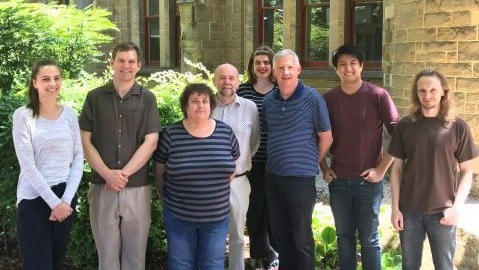 MSLC team at The University of Melbourne I was really feeling the pressure in the lead-up to the start of the semester. A post appearing on “UniMelb Love Letters”, a popular Facebook page among the students, did nothing to settle my nerves. How was I supposed to follow Yao-ban when he is so popular and well-loved among the students? 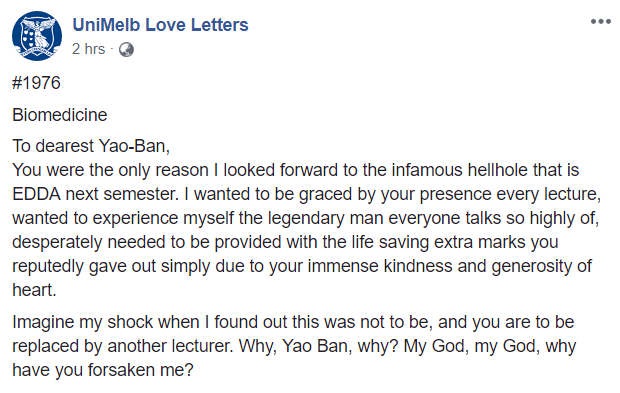
My First Mathematics LectureFinally, it was time for that first lecture. Sleep deprived, stressed and scared of messing up, I walked into the lecture theatre and saw the students staring back at me. I was surprised at the relief I felt. Actual students were far less scary than empty seats, and I realised that they were probably more intimidated by me than I was by them. Two pieces of the previously mentioned solicited advice resonated with me throughout the semester. The first was “Don’t talk at them, explain to them.” Prior to this I’d thought of public speaking more like reeling off some memorised script while trying not to black out – usually I’d have very little recollection afterward of what had happened. Public speaking didn’t come naturally to me, to say the least. I began to explain things to my audience like I would if I was one-on-one with a student, which was something I knew how to do and was comfortable with. The second piece of advice was given by a colleague at La Trobe: “Remember where you came from.” I had a great experience as a student at La Trobe. This advice reminded me to not only offer my students the same experience, but to stay true to myself. I’d had many fantastic lecturers and teachers in the past, but it was important for me to develop my own style and not copy someone else’s. I realised that I found it difficult to talk for 50 minutes straight, so I would try to break up the lecture into two or three sections with some sort of interactive activity (discussion, question, poll, statistics-related game or story) in between. This gave me (and the students) a much-needed break to reset focus and concentration. Slowly the amount of preparation I was doing before each lecture reduced. I was still getting nervous but was able to settle down once I started speaking. It wasn’t until week 9 or 10 that I started to feel more relaxed and became comfortable “winging it” a little more. When it was time to say goodbye to my students at the end of the very last lecture, I was surprisingly emotional. Partly because I really liked this group (I’m sure that I’ll remember some of them forever), but mostly because of the sheer effort it took to get through that first semester. It had felt like a constant battle to keep on top of all my work, and I’d spent so much time out of my comfort zone and in a heightened state of stress. Ending that last lecture, I realized just how exhausted I was. But I was also very proud of myself for stepping up to the challenge and seeing it through. I felt like I had been battling a beast, and the beast had finally been slain. Tips For First Time Mathematics LecturersSo here are some personal lessons that I’d like to share from this first lecturing and co-ordinating experience:
What can we do to help new lecturers (particularly those fresh out of a PhD with little to no experience)?
1 Comment
|
Archives
February 2023
Categories |
 RSS Feed
Recordings of sessions
Thursday - welcome
We are pleased to announce that the theme of this year's FYiM workshop to be held in Brisbane is
Celebrating 10 years of First Year in Maths!
Our first forum was in 2013 at The University of Melbourne. Let's look back on 10 years of talking about teaching maths and statistics at the first-year level. What is still relevant? What has changed? What new challenges lie ahead?
Here is the programme.
Details of the workshop are:
When: Thursday 6 July and Friday 7 July - 10 am to 5 pm
Where: The University of Queensland, St Lucia campus and via Zoom
Cost: FREE! Morning tea, lunch and afternoon tea will be provided thanks to UQ's School of Maths and Physics. You are welcome to join us for dinner (at own cost) on Thursday night at a local/CBD restaurant.
We look forward to seeing you in sunny Brisbane!
Deb, Don and Michael
FYiMaths National Steering Committee
Thursday - welcome
We are pleased to announce that the theme of this year's FYiM workshop to be held in Brisbane is
Celebrating 10 years of First Year in Maths!
Our first forum was in 2013 at The University of Melbourne. Let's look back on 10 years of talking about teaching maths and statistics at the first-year level. What is still relevant? What has changed? What new challenges lie ahead?
Here is the programme.
Details of the workshop are:
When: Thursday 6 July and Friday 7 July - 10 am to 5 pm
Where: The University of Queensland, St Lucia campus and via Zoom
Cost: FREE! Morning tea, lunch and afternoon tea will be provided thanks to UQ's School of Maths and Physics. You are welcome to join us for dinner (at own cost) on Thursday night at a local/CBD restaurant.
We look forward to seeing you in sunny Brisbane!
Deb, Don and Michael
FYiMaths National Steering Committee
|

|

|
